Etsy Search Engine Optimization: The Complete Guide to Getting Found in 2026
Learn Etsy search engine optimization the right way: fix titles, tags, and listing quality score to rank higher and get more organic sales. Try BeeSerp free.
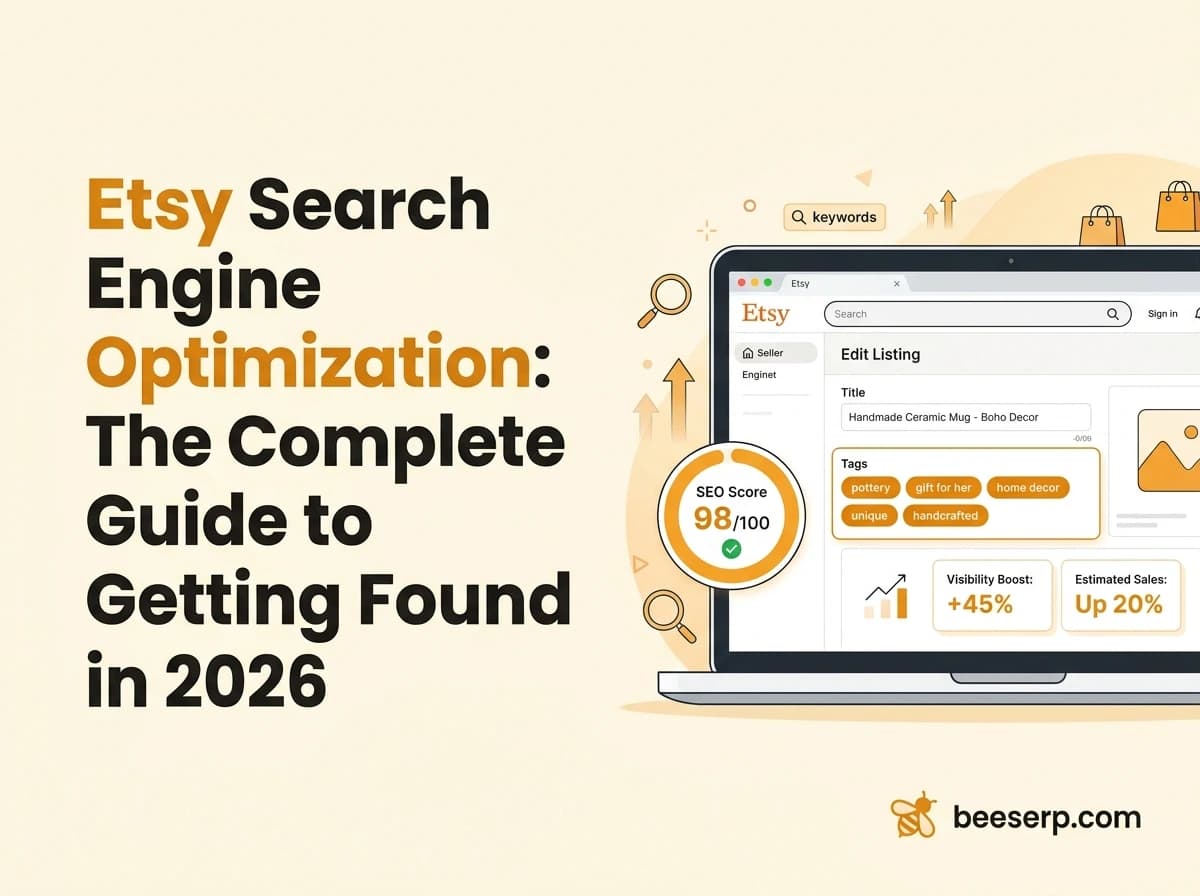
You published a listing three weeks ago. Zero views. You checked your tags, wrote a decent title, even added a few keywords you saw a competitor using — and still nothing. If this sounds familiar, you're not doing anything wrong as a maker. You're just missing how Etsy's search engine actually decides who gets seen.
Etsy search engine optimization isn't about tricking an algorithm. It's about giving Etsy's system the exact signals it needs to match your product with a buyer who's already typing that search into the box. Get this right and your listings start pulling traffic on their own, without ads.
This guide walks through exactly how Etsy SEO works in 2026, the steps to fix a listing that isn't ranking, the mistakes that quietly kill visibility, and how to check your work without guessing.
Why This Matters for Etsy Sellers
- Search is still Etsy's #1 traffic source. Most buyers never leave the search results page — if you're not on it, you don't exist to them.
- Ads amplify SEO, they don't replace it. A poorly optimized listing wastes ad spend because Etsy's own ranking still filters who sees your promoted result.
- Listing quality score compounds over time. Etsy tracks click-through rate and favorites against impressions — a weak start makes every future search harder to win.
- Star Seller status feeds back into ranking. Fast shipping and response times aren't just a badge; they're a trust signal Etsy factors into visibility.
- Seasonal keywords shift fast. A title optimized for "gift" in October needs different language in January — sellers who never revisit old listings leave money on the table.
- Your competitors are already doing this. Etsy search is relative — you're not being judged against a standard, you're being judged against everyone else selling something similar right now.
How to Optimize Your Etsy Listings for Search Step by Step
- Find your real keyword, not your assumed one. Search your product idea on Etsy and read the autocomplete suggestions — that's what real buyers type, not what you think they type.
- Front-load your title with the strongest keyword. Etsy's algorithm weights earlier words in the title more heavily, so lead with the exact phrase buyers search, not your brand name.
- Use all 13 tags with multi-word phrases. Single-word tags like "jewelry" compete with millions of listings — a phrase like "minimalist gold necklace" narrows your competition and matches intent more precisely.
- Match tags to title language, not duplicate it. Repeating the same words wastes tag slots — use tags to cover synonyms and related searches your title doesn't already capture.
- Write your description for humans first, keywords second. Etsy's algorithm barely weighs description text for ranking, but a clear, honest description drives the click-through and favorites that actually move you up.
- Price and photograph to convert, not just to rank. A listing that ranks well but never gets clicked or bought will drop back down — visibility and conversion have to work together.
- Recheck and refresh every 60–90 days. Trends shift, competitors update their listings, and a title that worked last quarter can quietly go stale.
Common Mistakes Etsy Sellers Make
Keyword stuffing the title
Cramming ten keywords into one title reads as spam to buyers and doesn't help ranking the way sellers assume. Etsy rewards relevance, not volume — pick the two or three phrases that actually describe the product and write a title a human would click.
Leaving tags empty or repetitive
An unfilled tag is a wasted opportunity Etsy's algorithm can't use to match you to a search. Just as common: filling all 13 tags with near-identical phrasing instead of covering genuinely different ways buyers search.
Ignoring listing quality score
Sellers obsess over tags and titles while ignoring that Etsy tracks how buyers actually behave after landing on the listing. Low click-through or high bounce rate tells Etsy your listing isn't a good match, even if the keywords are technically right.
Never updating old listings
A listing that ranked well a year ago isn't guaranteed to rank well now — search trends, seasonal demand, and competitor activity all shift underneath you. Sellers who "set and forget" their best listings are often the first to lose ranking without knowing why.
How BeeSerp Helps You Do This Faster
Manually reverse-engineering Etsy's algorithm for every listing is slow, and most sellers don't have hours to spend guessing. This is where BeeSerp's AI listing generator earns its keep — it drafts SEO-structured titles, tags, and descriptions built around real Etsy search patterns, not generic keyword lists.
Once a listing is live, BeeSerp's SEO scorer checks it against the same signals Etsy's algorithm actually weighs — title structure, tag usage, and keyword placement — and tells you exactly what to fix, instead of leaving you to guess.
And because ranking is only half the equation, BeeSerp's profit tracker shows your real margin after Etsy fees on every sale that ranking brings in, so you're optimizing for listings that actually make money, not just ones that get clicks.
Compared to manually auditing listings in a spreadsheet, BeeSerp compresses what used to take an evening per listing into a few minutes — the AI draft, score, and fix cycle runs in one place.
Try BeeSerp free for 7 days.
Pro Tips to Get Better Results on Etsy
- Study your "Etsy Search Analytics" data monthly. It shows which keywords are actually driving views to your shop, not the ones you assumed would.
- Optimize your shop title and sections too. Etsy's algorithm considers shop-level signals, not just individual listings — an unoptimized shop name is a missed keyword slot.
- Don't chase every trend. A trending keyword with no relevance to your product will tank your click-through rate faster than it boosts your reach.
- Watch your competitors' updated listings, not just their tags. If a top competitor recently changed their main photo or price, that's often a signal they found something that converts better — worth testing yourself.
- Treat renewal timing strategically. Etsy gives a small temporary visibility boost to newly listed or renewed items — time renewals around your peak search windows when it makes sense.
Frequently Asked Questions
How long does it take for Etsy SEO changes to show results?
Usually one to two weeks for Etsy's algorithm to fully register a listing update and reflect it in search placement. Don't panic and re-edit daily — that resets some of the signals Etsy is trying to evaluate.
Do Etsy tags matter more than titles?
They work together, not against each other. Your title carries more ranking weight per word, but tags let you cover additional relevant phrases your title can't fit.
Can I use the same tags on every listing in my shop?
You can, but it's rarely optimal — each listing should have tags specific to what makes it different, or you're competing against your own products for the same searches.
Does Etsy Ads spend improve my organic SEO ranking?
Not directly. Ads and organic search are evaluated separately, though a well-performing ad can drive favorites and sales that indirectly help organic signals over time.
How many keywords should be in an Etsy title?
There's no fixed number — focus on 3 to 5 genuinely relevant phrases written in natural language rather than hitting a keyword count.
Is Star Seller status connected to search ranking?
Etsy has confirmed shop-level performance metrics like shipping speed and response time factor into visibility, and Star Seller reflects many of those same metrics.
What's the fastest way to check if my listing is actually optimized?
Run it through a dedicated SEO scoring tool like BeeSerp's, which checks your listing against the specific signals Etsy's algorithm evaluates, rather than relying on general keyword-density guesses.
Etsy search engine optimization isn't a one-time setup — it's an ongoing process of matching real buyer language to your listings, watching what actually converts, and adjusting as trends shift. The sellers who treat it that way are the ones who keep ranking, quarter after quarter.
Start with the listings you already have. Fix the titles, rework the tags, and check the results against real data instead of assumptions — small corrections compound fast once Etsy's algorithm starts trusting your shop.
If you'd rather not do this manually for every listing, BeeSerp's AI generator, SEO scorer, and profit tracker are built to handle the heavy lifting so you can focus on making and selling. Try BeeSerp free for 7 days.
Optimize your Etsy listings with AI
BeeSerp generates titles, 13 tags & full descriptions in seconds.
More Guides

Etsy Tools for Sellers: The Complete Guide to Keyword Research, SEO, and Analytics
Compare the best Etsy tools for sellers — keyword research, SEO scoring, tag generators, and analytics — plus how to use them the right way. Try BeeSerp free.
Marmalead vs EtsyHunt vs Alura vs BeeSerp: Which Etsy SEO Tool Is Actually Worth Paying For
Marmalead vs EtsyHunt vs Alura vs BeeSerp compared: keyword data, listing tools, and pricing broken down. See which Etsy SEO tool wins. Try BeeSerp free.
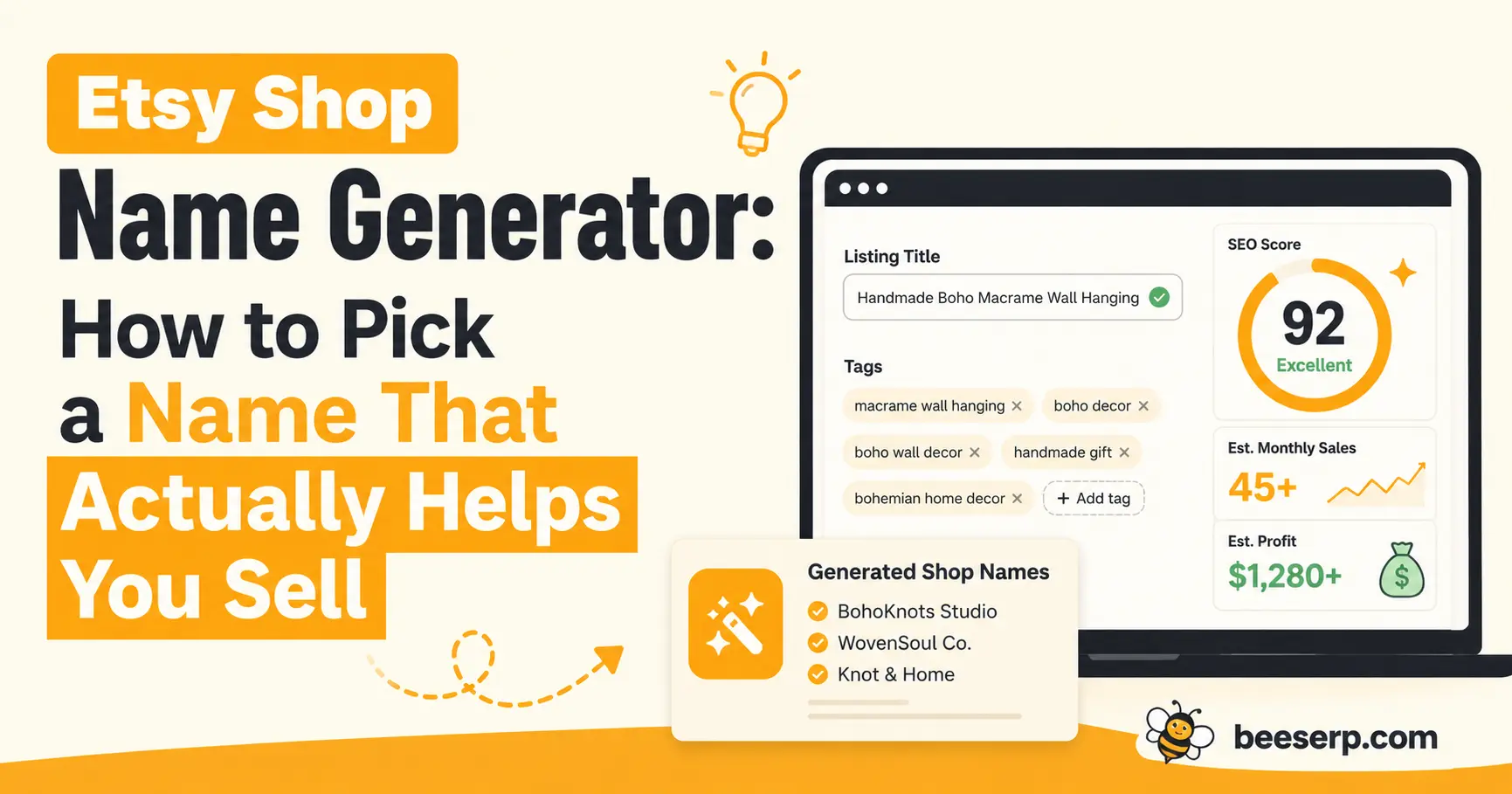
Etsy Shop Name Generator: How to Pick a Name That Actually Helps You Sell
Pick an Etsy shop name that sells. Learn the rules, what actually works in 2026, and how to use a generator to find your best options fast.