eRank vs BeeSerp: Which Etsy SEO Tool Actually Helps You Sell More in 2026?
eRank vs BeeSerp compared: keyword data, listing tools, rank tracking, and where each one falls short. See which Etsy SEO tool actually gets your listings published. Try BeeSerp free.
eRank shows up in almost every "best Etsy SEO tool" conversation, and for good reason. It's been around for years, it has a free tier that actually works, and a lot of sellers learned Etsy keyword research using its keyword tool as their first real tool. If you've searched "erank etsy" or "erank for etsy" trying to decide whether it's worth upgrading to a paid plan, or whether something else does the job better, this is the comparison you're looking for.
This article breaks down what eRank actually does well, where sellers say it falls short, and where BeeSerp fits into that picture. No vague "industry-leading" claims, just what each tool is built for and what that means for your shop.
Why Choosing the Right Etsy SEO Tool Actually Matters
- Your keyword data determines your title and tags. If the tool's data is stale or too narrow, your entire SEO strategy is built on a shaky foundation before you even publish.
- Time spent switching tools is time not spent listing. Every hour you burn learning a new dashboard is an hour you're not researching your next product.
- A free plan can quietly cost you more than a paid one. If a tool caps your searches or hides its best data behind a paywall, you end up guessing anyway, just with extra steps first.
- Rank tracking without action items isn't that useful. Knowing you dropped from position 4 to position 12 doesn't help unless the tool also tells you what to fix.
- Trend data goes stale fast. Etsy search behavior shifts seasonally, and a tool with a small or infrequently updated dataset can't keep up.
- A shop that grows past a few listings needs more than keyword lookup. Eventually you need SEO scoring, profit tracking, and listing generation working together, not scattered across separate tabs and spreadsheets.
How to Evaluate an Etsy Keyword Tool Before You Pay for It
- Check how large and current the keyword database actually is. A tool pulling from a small or outdated dataset will keep surfacing the same tired suggestions everyone else is already using.
- Test it on a niche you already know well. If the tool's suggestions feel obvious or generic for a niche you understand, its data quality is probably weak everywhere else too.
- See if it explains competition, not just search volume. A keyword with high volume and impossible competition isn't an opportunity, it's a trap.
- Look for listing-level scoring, not just keyword lists and rank checks. Research and rank tracking are only part of the job. You need to know if your finished title and tags actually use that research correctly.
- Ask if it writes the listing for you, or just hands you a list of words. A long keyword list still leaves you staring at a blank title field. Some tools stop at research; others carry it through to a finished draft.
- Ask if it ties SEO to actual profit. Ranking for a keyword tied to a low-margin product isn't a win. The best tools connect SEO decisions to your real bottom line after fees.
- Try the free trial or free tier with a real listing you're about to publish. Don't test with a hypothetical product. Use the tool on something you're actually about to list, so you can judge it on real stakes.
eRank: What It Does Well (and Where It Falls Short)
eRank's biggest strength is accessibility. Its free plan gives new sellers a genuinely usable keyword tool, a basic rank checker, and a Chrome extension for peeking at competitor listings without committing to a subscription. That's a meaningful reason it's often the first SEO tool a new Etsy seller ever touches, and plenty of sellers have built a real workflow around its keyword explorer and tag search over the years.
Where sellers say eRank starts to show its age is on the "now what" step. eRank is fundamentally a research and tracking tool: it tells you what to search for and where you currently rank, but it doesn't write your title, tags, or description for you. Once you've pulled your keyword list, you're still the one building the listing by hand, the same way you would with a spreadsheet of keywords and no tool at all. Sellers managing more than a handful of listings often describe hitting a point where the manual keyword-to-listing step becomes the actual bottleneck, not the research itself.
The other common complaint is that eRank's interface, built up over many years of added features, can feel cluttered compared to newer tools designed around a single streamlined workflow. Between the keyword tool, rank checker, listing audits, and shop stats living in separate tabs, sellers sometimes say they only ever use two or three of eRank's many features and ignore the rest simply because they're hard to find.
Common Mistakes Sellers Make Comparing Etsy SEO Tools
Staying on a free plan out of habit, not evaluation
A free tier is a great way to start, but "free" and "the right tool for where my shop is now" aren't the same thing. If your shop has grown past a handful of listings, it's worth actually comparing what a paid tool unlocks instead of assuming free is automatically the smarter choice.
Treating keyword research and listing writing as permanently separate steps
Researching a keyword and then manually building a title around it works, but it's slow and error-prone at scale. Tools that combine research and generation in one pass save real time once you're managing more than a few products.
Chasing rank position without checking if it's converting
Climbing to position 3 for a keyword means nothing if buyers searching that term aren't the ones who actually buy what you sell. Rank tracking is only useful alongside conversion data, not instead of it.
Never checking how current the keyword database actually is
Sellers rarely ask how often a tool's keyword data refreshes. A stale dataset will quietly steer you toward the same overused terms every other seller using that tool is also targeting.
Where BeeSerp Fits In
BeeSerp was built to pick up exactly where eRank's research-and-tracking model leaves off. Instead of handing you a keyword list and a rank number and leaving the rest to you, BeeSerp pulls from a database of over 100 million Etsy keywords and carries that data straight into an AI-generated title, tag set, and description, then scores the finished listing against the same signals Etsy's algorithm actually uses.
That means the keyword research isn't a separate step you do before opening a blank listing form. It's the input to a draft you can publish in minutes, not the start of twenty minutes of manual title-writing. Where eRank stops at "here's what to search for," BeeSerp continues on to "here's your finished listing, already built around it."
The profit tracker is worth calling out specifically. Neither eRank's free nor paid tiers tie keyword performance directly to your real margins after Etsy fees. BeeSerp does, which means you can tell the difference between a keyword that ranks well and one that's actually worth chasing for your specific product and price point.
None of this makes eRank a bad tool. If all you need is a keyword lookup and a rank check, its free plan still does that job. But if you're past the point where researching in one place and writing listings by hand in another feels efficient, that's the specific gap BeeSerp was built to close.
Try BeeSerp free for 7 days and run it against eRank on a real listing you're about to publish. That's the only comparison that actually matters.
Pro Tips for Getting More Out of Any Etsy SEO Tool
- Don't research in isolation from your own shop's data. Cross-check any tool's keyword suggestions against what's already driving traffic to your existing listings.
- Revisit your top listings every couple of months, not just new ones. Sellers pour research effort into new products and forget that older, proven listings need the same periodic check.
- Use competition data to pick your battles. A slightly lower volume keyword with real, winnable competition often outperforms a high volume term you'll never rank for.
- Don't chase every trending keyword a tool surfaces. If it has nothing to do with what you actually sell, ranking for it won't convert into sales.
- Combine keyword research with pricing and margin data before committing to a niche. A great keyword tied to a product with thin margins isn't the opportunity it looks like on paper.
Frequently Asked Questions
Is eRank still worth using in 2026?
eRank remains a solid entry point for new sellers who want a free keyword and rank tracking tool, and plenty of established sellers still use it for exactly that. It's less useful if you want listing generation, SEO scoring, and profit tracking built into the same workflow.
What does eRank's free plan actually include?
eRank's free tier gives you access to its keyword explorer, basic rank checking, and browser extension, which is more functionality than most competing tools offer for free. The paid tiers add higher usage limits and additional research and audit features.
What makes BeeSerp different from eRank?
BeeSerp combines a keyword database of over 100 million Etsy search terms with AI listing generation, SEO scoring, and profit tracking in one platform, rather than stopping at research and rank tracking. That means you can research, draft, score, and check profitability without switching tools or writing your title by hand.
Can I use eRank and BeeSerp at the same time?
Plenty of sellers do, especially while comparing them, since eRank's free plan costs nothing to keep running alongside a BeeSerp trial. Most eventually settle on whichever tool covers more of their actual workflow in one place.
Does a bigger keyword database actually matter for a small shop?
Yes. Even a small shop benefits from a wider keyword database because it surfaces long-tail phrases with real search intent and less competition, which are often easier wins than the obvious high-volume terms everyone else is targeting.
Which tool is best for a brand new Etsy seller?
New sellers generally do better with a tool that combines research and listing generation, since writing SEO-strong titles and tags from scratch is the hardest part early on. That's the specific gap BeeSerp was built to fill, though eRank's free plan is still a reasonable place to learn keyword basics first.
Does using an SEO tool guarantee better Etsy rankings?
No tool can guarantee ranking, since Etsy's algorithm also weighs factors like click-through rate, conversion, and shop performance that happen after the listing is published. What a good tool can do is make sure your title, tags, and description give the algorithm the strongest possible signals to work with.
There's no single objectively best Etsy SEO tool. eRank has earned its place as a go-to free option, and if it's already covering what you need, that's a legitimate reason to stay.
But if you're tired of researching keywords in one tool and then writing listings by hand somewhere else, that's exactly the workflow BeeSerp was built to replace. A 100 million plus keyword database paired directly with AI listing generation and profit tracking means fewer tabs open and less manual work per listing.
Try BeeSerp free for 7 days and see how it handles a listing you're about to publish anyway.
Optimize your Etsy listings with AI
BeeSerp generates titles, 13 tags & full descriptions in seconds.
More Guides
Marmalead vs EtsyHunt vs Alura vs BeeSerp: Which Etsy SEO Tool Is Actually Worth Paying For
Marmalead vs EtsyHunt vs Alura vs BeeSerp compared: keyword data, listing tools, and pricing broken down. See which Etsy SEO tool wins. Try BeeSerp free.
Etsy Search Engine Optimization: The Complete Guide to Getting Found in 2026
Learn Etsy search engine optimization the right way: fix titles, tags, and listing quality score to rank higher and get more organic sales. Try BeeSerp free.
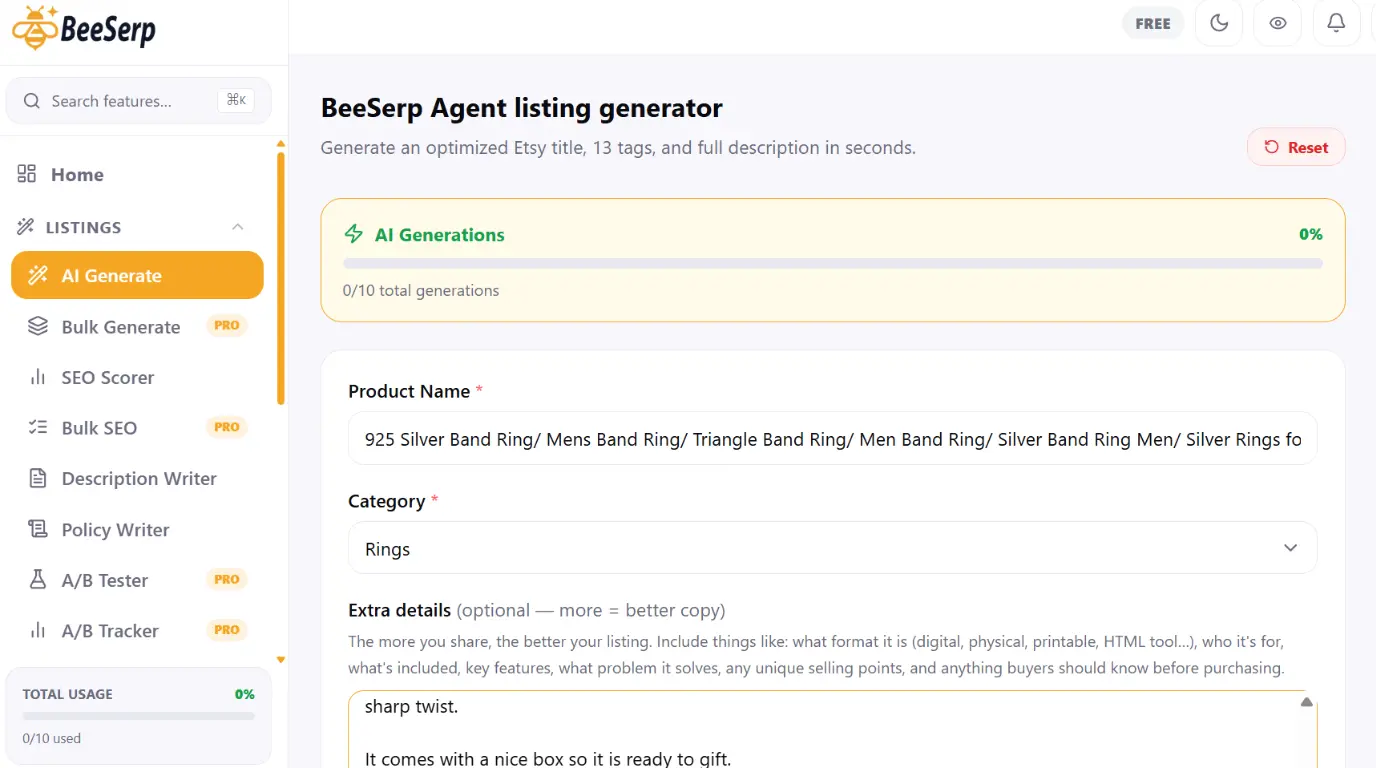
How to Write an Etsy Listing Title That Actually Ranks (2026 Guide)
A step-by-step 2026 guide to writing Etsy listing titles that rank — covers keyword placement, character limits, common mistakes, and how BeeSerp's SEO scorer and AI generator help you fix titles fast.